
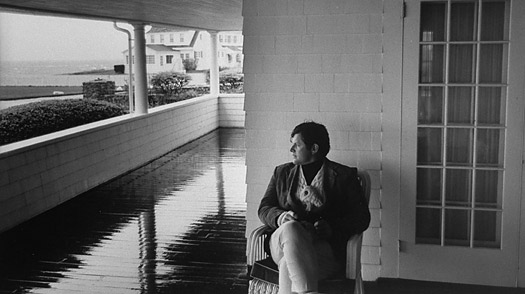
Sen. Ted Kennedy, sitting on a porch relaxing.
Here was Ted Kennedy, 74-year-old son, brother, father, husband, Senator, living history, American legend. He was sitting on a wicker chair on the front porch of the seaside home that held so much of his life within its walls. He was wearing a dark blue blazer and a pale blue shirt. He was tieless and tanned on a spectacular October morning in 2006, and he was smiling too because he could see his boat, the Mya, anchored in Hyannis Port harbor, rocking gently in a warm breeze that held a hint of another summer just passed. Election Day, the last time his fabled name would appear on a ballot, was two weeks away.
"When you're out on the ocean," he was asked that day, "do you ever see your brothers?"
"Sure," Kennedy answered, his voice a few decibels above a whisper. "All the time ... all the time. There's not a day I don't think of them. This is where we all grew up. There have been some joyous times here. Difficult times too.
"We all learned to swim here. Learned to sail. I still remember my brother Joe, swimming with him here, before he went off to war. My brother Jack, out on the water with him ... I remember it all so well. He lived on the water, fought on the water."
He paused then, staring toward Nantucket Sound. Here he was not the last living brother from a family that had dominated so much of the American political landscape during the second half of the 20th century; he was simply a man who had lived to see dreams die young and yet soldiered on while carrying a cargo of sadness and responsibility.
"The sea ... there are eternal aspects to the sea and the ocean," he said that day. "It anchors you."
He was home. Who he was — who he really was — is rooted in the rambling, white clapboard house in Hyannis Port to which he could, and would, retreat to recover from all wounds.
"How old were you when your brother Joe died?" Ted was asked that morning.
"Twelve," he replied. "I was 12 years old."
Joe Kennedy Jr., the oldest of nine children, was the first to die — at 29 — when the plane he was flying on a World War II mission exploded over England on Aug. 12, 1944.
"Mother was in the kitchen. Dad was upstairs. I was right here, right on this porch, when a priest arrived with an Army officer. I remember it quite clearly," Kennedy said.
Kennedy remembered it all. The wins, the losses and the fact there were never any tie games in his long life. Nobody was neutral when it came to the man and what he accomplished in the public arena. And few were aware of the private duties he gladly assumed as surrogate father to nieces and nephews who grew up in a fog of myth.
He embraced strangers. Brian Hart met Kennedy at Arlington National Cemetery on a cold, gray November day in 2003. Brian and his wife Alma were burying their 20-year-old son, Army Private First Class John Hart, who had been killed in Iraq. "I turned around at the end of the service, and that was the first time I met Senator Kennedy," the father of the dead soldier said. "He was right there behind us. I asked him if he could meet with me later to talk about how and why our son died — because he did not have the proper equipment to fight a war. He was in a vehicle that was not armored.
"That month Senator Kennedy pushed the Pentagon to provide more armored humvees for our troops. Later, when I thanked him, he told me it wasn't necessary, that he wanted to thank me for helping focus attention on the issue and that he knew what my wife and I were feeling because his mother — she was a Gold Star mother too.